

An interview with Stefan Leithenmayr:
How we’re integrating AI safely and effectively at Zentro
Artificial intelligence is changing the way we work with software. Together with our research partner RISC Software from Hagenberg, we are investigating how AI can be integrated into Zentro in a meaningful, secure and sustainable way. For us, the focus is not on the technology itself, but on its concrete benefits for you: time savings, reduced manual effort and a better basis for decision-making.
We spoke to Stefan Leithenmayr, our project manager on the Zentro side, about specific applications, data protection and the future of business software.
AI with control.
“AI is designed to take some of the workload off our customers – they retain control themselves.”
Stefan Leithenmayr, Eng.
Project Manager, AI Research Project, Zentro

Why AI for Zentro?
How important is artificial intelligence for Zentro’s future development?
We see AI as a major opportunity to rethink business processes. It can standardise and speed up workflows more effectively and, ultimately, reduce costs. However, we are not interested in using AI at any cost – what matters is where it actually adds value.
What is the focus of the research project with RISC Software?
A language model on its own knows neither a company’s processes nor its data. It is only through targeted integration with the ERP system that truly interesting applications emerge. We are therefore investigating how AI systems can access information, recognise operational contexts and support or automate selected tasks.
Alongside the technology, we place equal emphasis on cost-effectiveness, data protection, security and long-term maintainability.
Let’s start with the reports. What’s changing there?
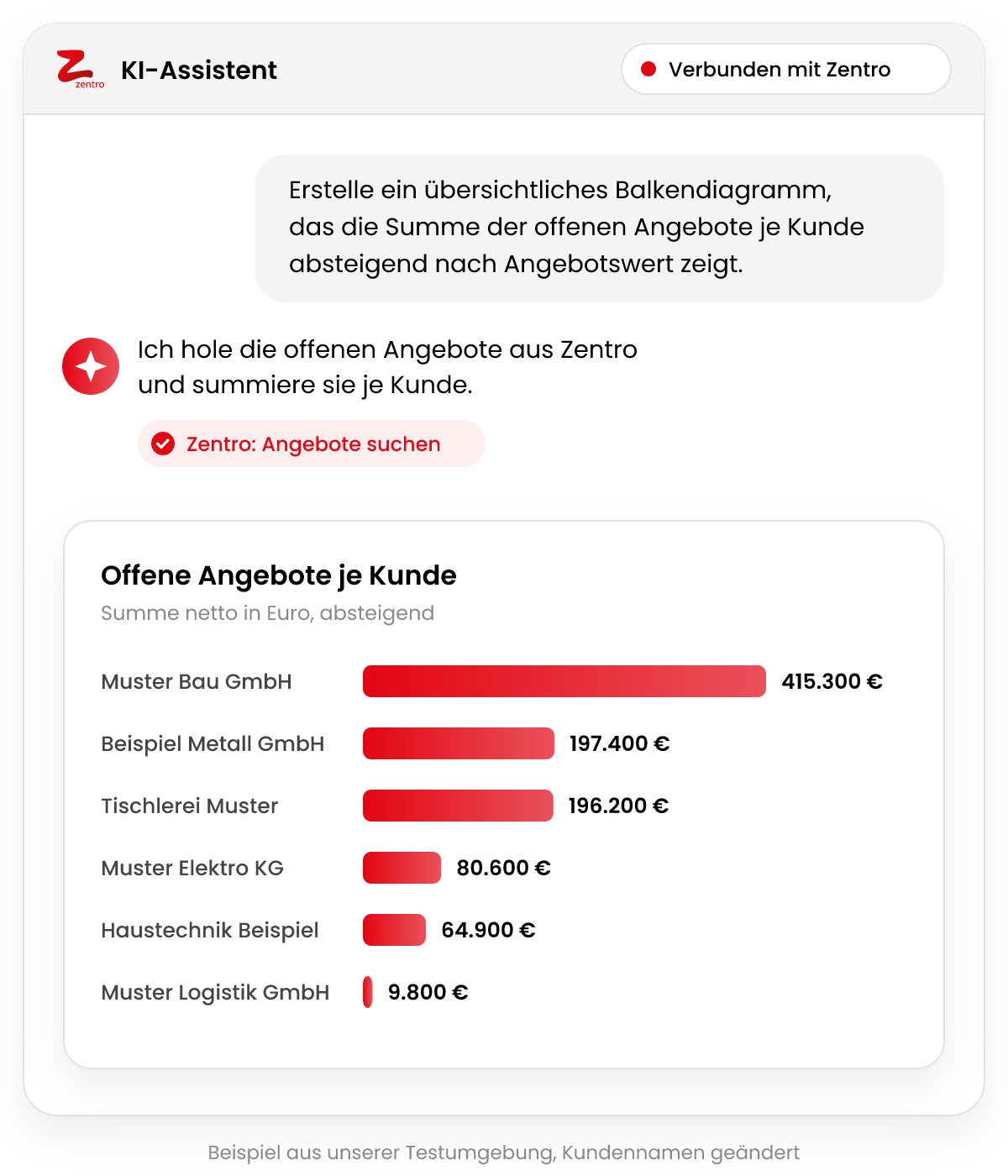
At present, you call up reports or set up filters yourself. In future, all it will take is one question:
“Which quotes over 20,000 euros are currently still open?”
“Which projects exceeded their budgeted costs in the last quarter?”
The AI retrieves the data from Zentro and presents it as a table, chart or summary. In future, it will also highlight anomalies that are easily overlooked in day-to-day operations – such as unusual cost trends, deviations in projects or changes in the order book. We see great potential here, particularly for business intelligence.
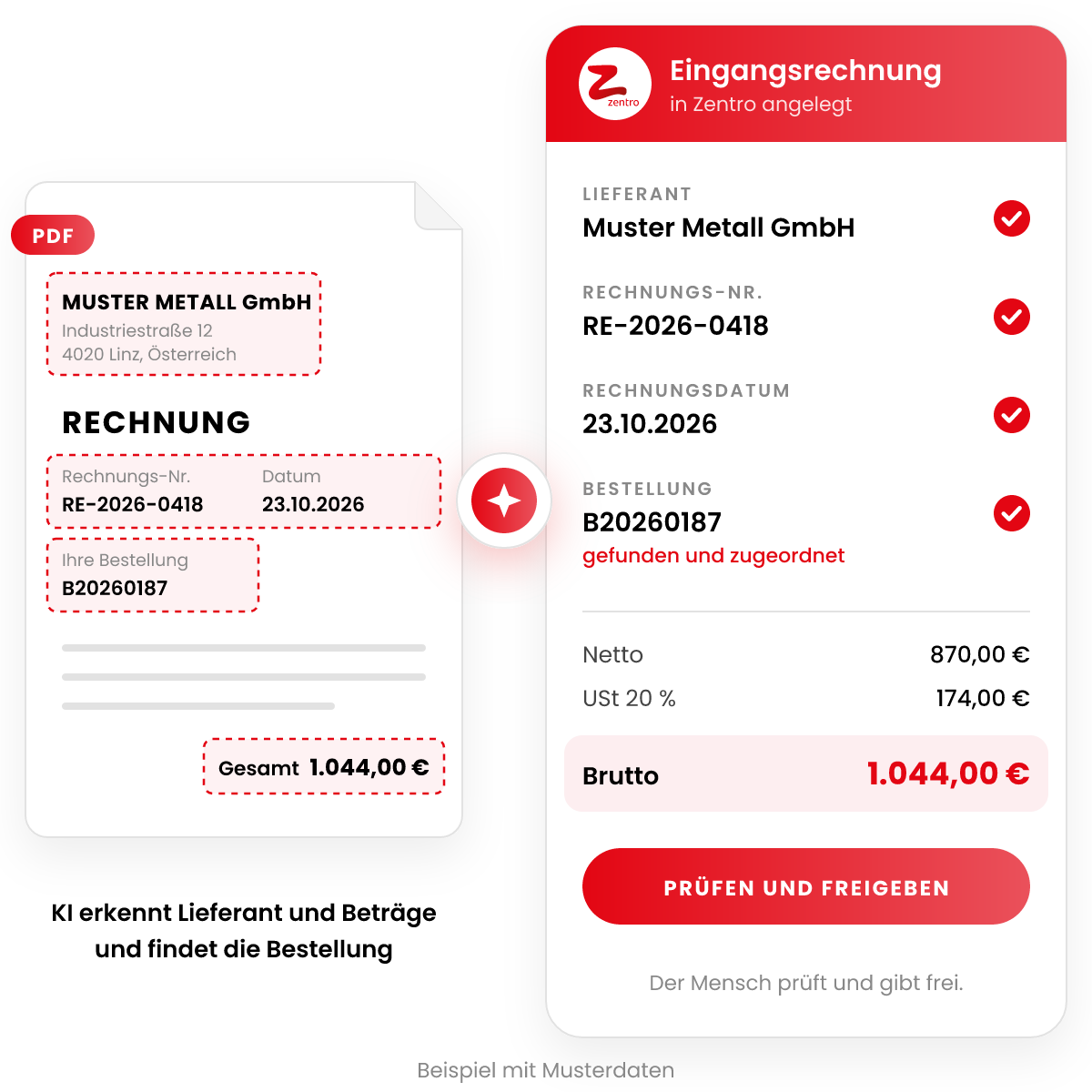
How does AI assist with invoice recognition?
Incoming invoices are recognised and scanned. The AI finds the corresponding order in Zentro and matches the invoice to it. The AI flags up any discrepancies between the order and the invoice for review.
And when it comes to preparing quotations?
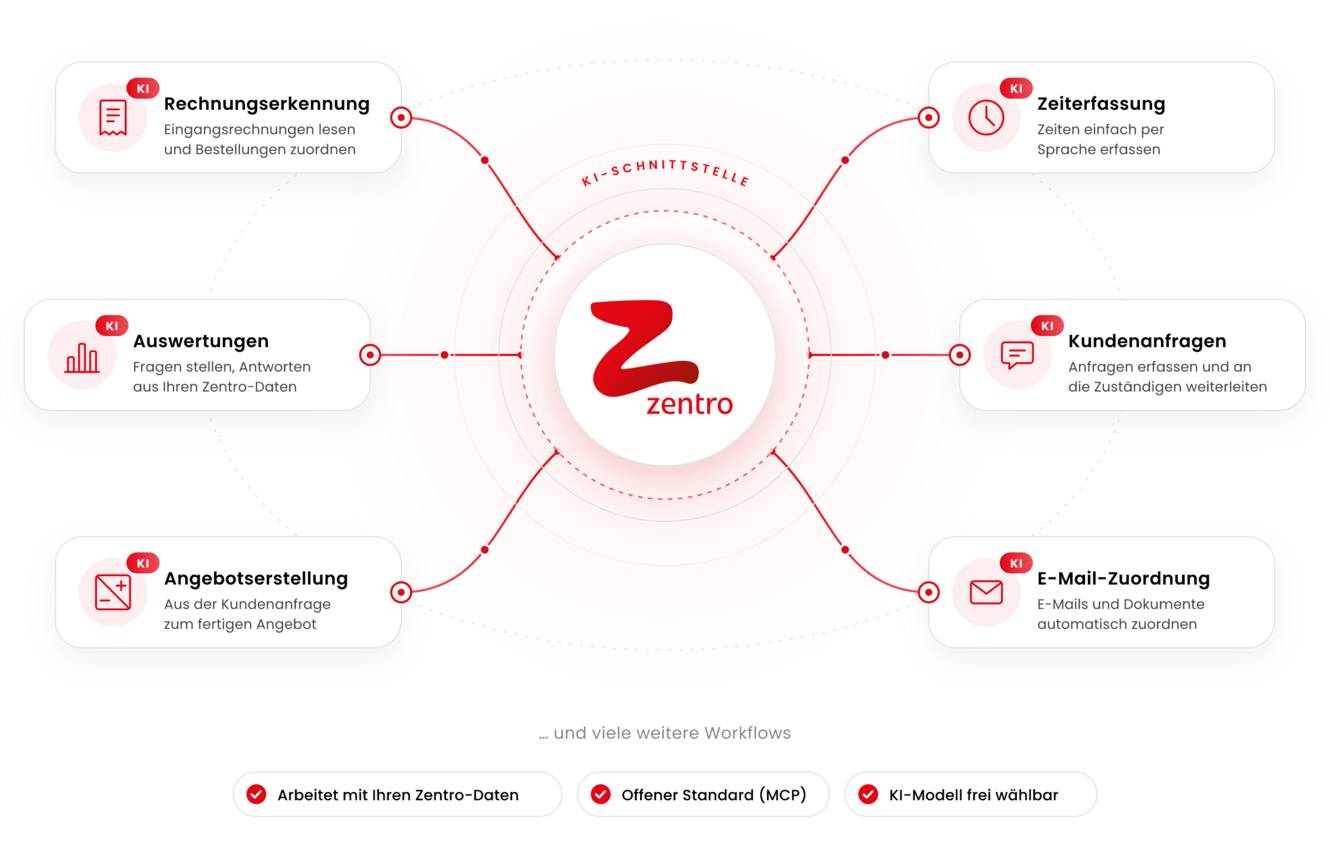
AI can prepare quotations and remind staff of open tenders. In the long term, it could also identify additional sales opportunities, for example through complementary products or services. However, personal customer relationships and important decisions remain the responsibility of humans.
What exactly do you do in the area of time recording?
Staff simply state what they’ve been doing:
“Log three hours for today on the Müller project for assembly.”
The AI recognises the project, duration and activity and prepares the time entry. This makes things considerably easier when recording time on the go, such as on building sites or in production.
What happens to incoming customer enquiries?
Incoming enquiries – whether by email or from call notes – are analysed, recorded in a structured manner and forwarded to the relevant staff members. The AI determines whether the enquiry is a new one, a follow-up to an existing quote or a request for general information.
How the integration
How does an AI system gain access to the ERP data?
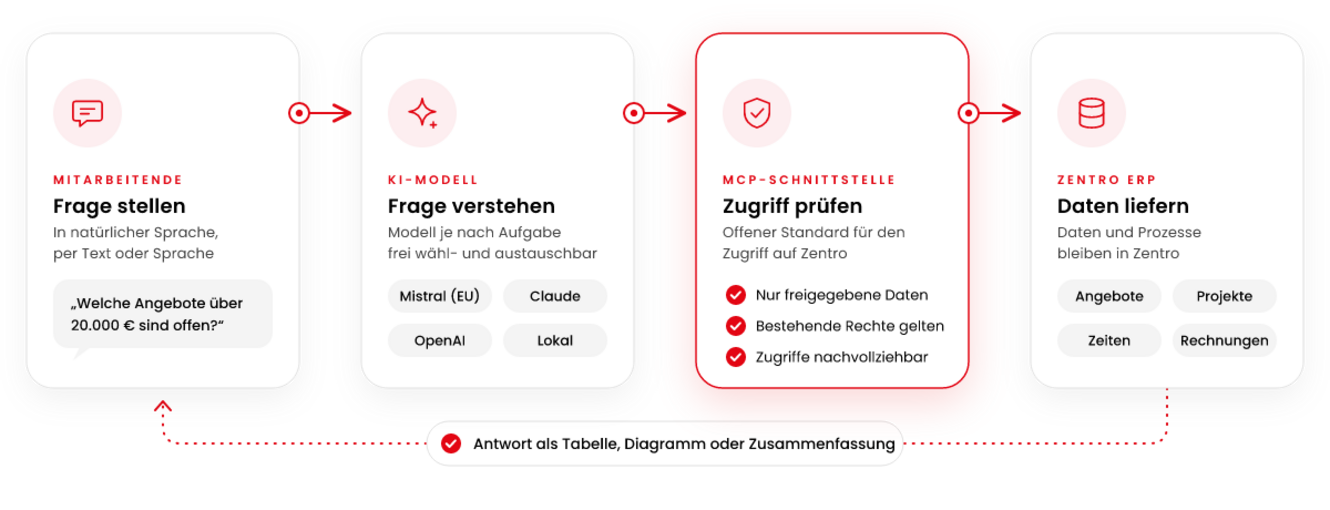
The integration takes place via an interface, such as the Model Context Protocol (MCP). Using this open standard, AI systems access shared information and functions from Zentro via a standardised interface. The main strength currently lies in analytics: rather than setting filters or searching for reports, staff simply ask a question and receive the answer directly from the Zentro data.
Importantly, sensitive data remains protected. The AI only receives the information authorised for its task – the existing permissions in Zentro also apply to it. We make a conscious decision about which data goes to which AI model. We ensure that personal data is processed in Europe in accordance with the GDPR. More on this later in the discussion.
The big advantage is that we are not tied to a single AI provider. Depending on the task and the sensitivity of the data, different models can be used: for sensitive data, for example, models from the European provider Mistral or locally operated models; for other tasks, Claude from Anthropic or models from OpenAI. This allows us to select the most suitable model for each task based on data protection, performance and cost, and to swap it out if necessary.
Business processes and data remain within Zentro. The AI provides additional support but does not take over data management. This allows us to utilise new developments without having to constantly rebuild the ERP solution.
Can the AI also create and edit data in Zentro?
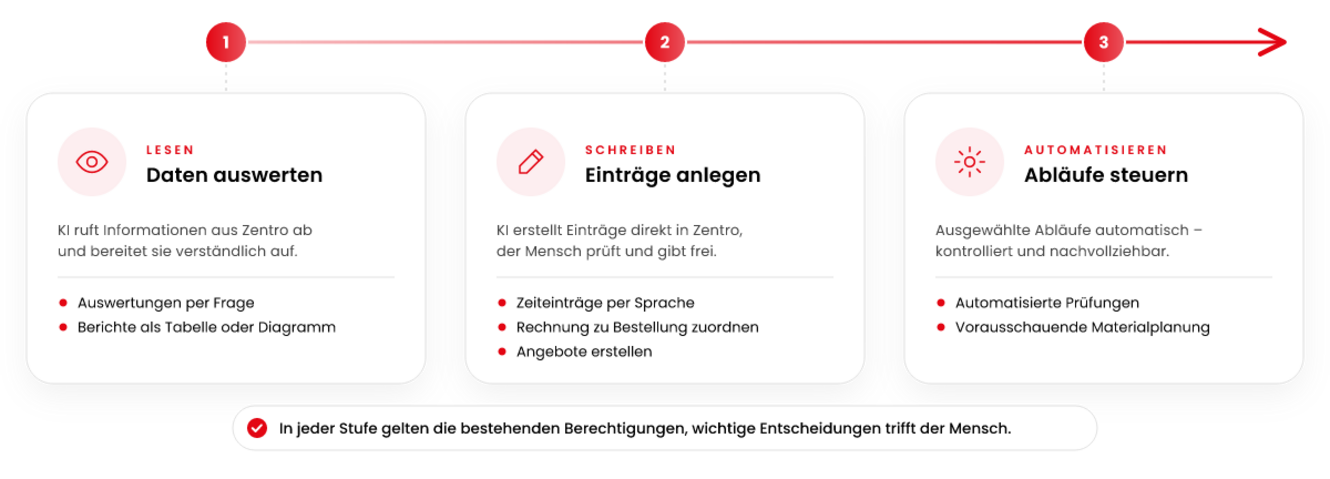
Yes. The AI not only retrieves information, but can also create entries directly in Zentro – such as time entries, quotations or the allocation of invoices to orders. We define the extent to which it is permitted to act autonomously in three stages: initially, it merely reads and analyses data. At the second level, it creates entries that a human checks and approves. At the third level, it automatically manages selected processes – in a controlled and traceable manner.
Why this tiered approach? Language models can make mistakes or misinterpret information. This is less critical during an analysis than in the case of an automated posting with financial implications. That is why we specifically safeguard write functions and determine, on a task-by-task basis, when a human must check and approve them.
Control, Data Protection and security
You compare AI to a new employee. What do you mean by that?
The comparison clearly illustrates what is possible – and where the limits lie. Nobody would give a new employee unrestricted access to all company data on their first day. We should treat AI in exactly the same way:
New employee | AI system |
|---|
| In comparison | ||
| Is given a clearly defined task | Yes | Yes |
| Is granted only the permissions necessary for the task | Yes | Yes |
| Results are checked | Yes | Yes |
| Brings their own experience and takes responsibility | Yes | No |
| Understands the operational consequences of their actions | Yes | No |
For example, an AI that evaluates offers does not need access to personnel or financial data. And when it comes to important decisions and changes to data, there are clear rules governing when a human must carry out a check.
We do not grant the AI as many rights as possible, but only those it needs for its specific task.
What do you look out for when it comes to data protection and security?
ERP systems contain sensitive information – ranging from personal data and customer relationships to internal prices and calculations. It makes a big difference whether an AI generates general text or an external system receives detailed customer data. Before any integration, we therefore clarify where the data is processed, which providers are involved and what safeguards are in place.
Clear guidelines apply here:
- Legal framework: General Data Protection Regulation (GDPR), the European AI Act and other security requirements
- Authorisations: The existing rights within Zentro also apply to the AI. Just because it could technically access data does not mean it is permitted to do so.
- Data minimisation: only the information that is actually necessary for the task
- Security: secure data transmission and traceable actions
- European and local models: We are currently working with models from the European provider Mistral, amongst others, and are testing their operation in controlled or local environments.
Companies should retain control over their data and make informed decisions about which information is used for which tasks.
What role does sustainability play?
For us, sustainability means, above all, being sensible and cost-effective in the long term. Not every task requires a large, computationally intensive model – often, smaller, specialised or locally operated models are sufficient. We pay close attention to the balance between benefits, resource consumption, operating costs and maintenance requirements. A solution is only sustainable if it does not merely make a short-term impression, but offers genuine added value over many years.
Our Guiding principle
“Not everything that can be automated from a technical point of view is necessarily sensible from an organisational perspective. Functions
must operate reliably, integrate seamlessly into existing processes and offergenuine
added value.”
Tips for getting started
What mistakes can you make when using AI technologies at the moment?
Most mistakes stem from too much enthusiasm or too little caution:
- Carelessly sharing sensitive data: Anyone who simply copies customer information or personal data into a public AI tool relinquishes control over where that data is processed.
- Blindly trusting results: Language models can make mistakes or misinterpret information. Particular care and appropriate control mechanisms are essential, especially when dealing with quotes, invoices or other decisions with financial implications.
- Granting AI too many permissions: AI should only be granted access to the data it needs to perform its task – not blanket access to all company data.
- Using AI at any cost: Not every process benefits from AI. Without a clear benefit, it simply creates additional work.
- Becoming tied to a single provider: Development is so rapid that today’s best solution may be obsolete by tomorrow. Open interfaces ensure that a switch remains possible.
What advice would you give to companies that have not yet engaged much with AI?
- Be open-minded: AI will bring about lasting changes to many work processes. Those who gain experience early on will be better placed to recognise both the opportunities and the risks.
- Start small: rather than tackling large projects, begin with individual, manageable use cases and assess where time is genuinely saved or quality improved.
- Remain critical: AI does not automatically produce correct results, and confidential data deserves special attention.
A look into the future
What might working with Zentro look like in a few years’ time?
Templates, spreadsheets and reports will still have their place. However, an increasing number of tasks will be carried out using natural language or through assistant functions. The AI brings together information from different areas of the business, identifies connections and suggests actions. In the long term, we also see potential in predictive materials planning, production control, automated checks and the identification of financial risks. Things will get really interesting when AI not only answers individual questions, but also provides targeted support to staff in their day-to-day processes.
What does this research project mean in practical terms for Zentro customers?
Easier operation, faster access to information, fewer manual tasks and a better basis for decision-making. Together with RISC Software, we are laying the foundations for integrating such functions into Zentro in a technically sound, secure and sustainable manner.
Our aim
“An ERP system that not only manages information but also provides employees with increasingly intelligent support
– whilst ensuring that control over data, access rights and decision-making
remains with the company.”
You would like to use AI in your business?
Whether you have an initial idea or a specific use case: get in touch with us! Together, we’ll work out
where AI can deliver the greatest benefits in your processes with Zentro, and we’ll be happy to advise you on
its implementation.
Please note: This article is for general information purposes only and does not constitute legal advice. For
a legal assessment of your specific use of AI, for example with regard to the GDPR or the EU AI Act,
please contact your professional body or your solicitor.
Do you have any questions? We will be happy to advise you.

We look forward to your call at
!

Please write to us at
by e-mail!

Zentro GmbH
Grubbachstr. 71
4644 Grünau im Almtal
Austria